Clock Dial Information
The dial is the face of the clock. It is attached to the movement by a number of brass “feet.” The dial has an important bearing on a clock’s price, and clocks with replaced dials are much less desirable.
Parts of a Dial
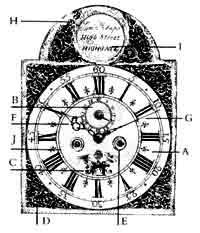
- Chapter ring
- Subsidiary dial
- Calendar aperture
- Applied corner spandrels
- Winding holes
- Hour hand
- Minute hand
- Dial arch
- Engraved boss
- “Matted” centre
Types of Dials
Brass Dials
The earliest type of dial, used on lantern, bracket and long-case clocks. The hours are engraved onto a detachable chapter ring.
Painted Metal Dials
Found on most clocks made after about 1800. They became increasingly elaborate during the 19th century.
Painted Wooden Dials
Found on English dial clocks, tavern clocks and continental clocks. If authentic, the wood will show some signs of cracking caused by changes in temperature.
Enameled Metal Dials
Common on carriage clocks and other types of French clock. They are made from enamel fired on top of thin copper.